

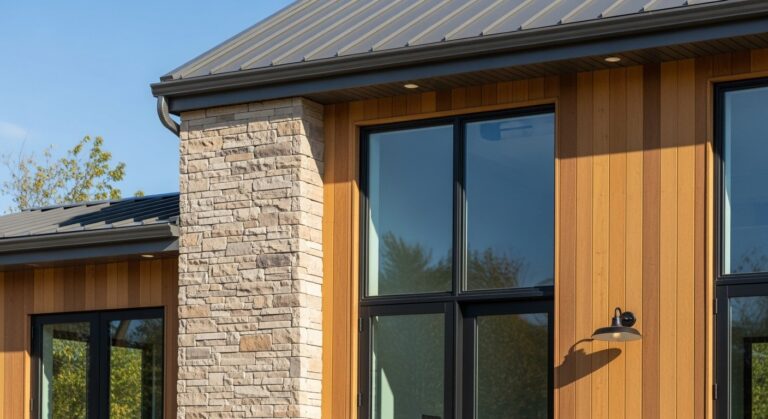
There’s a certain magic to a home exterior that just clicks.
It feels settled, confident. Complete.
Often, that feeling comes from a smart, intentional mix of materials.
And the classic trio of stone, wood, and metal, is a combination that rarely fails.
When it’s done right, anyway.
The Foundation of a Good Mix
Getting the balance right isn’t about giving each material equal billing.
It’s actually the opposite.
Most of the best designs follow a kind of 80/20 principle.
One material needs to be the clear lead. The main story.
This could be large expanses of warm cedar siding or the cool, solid presence of light-colored limestone. This dominant material covers the most ground and sets the overall tone.
The other two materials are the supporting cast.
They’re the accents. The texture. The punctuation.
They highlight a roofline, frame an entryway, or add a needed touch of warmth or sharpness.
This approach keeps the facade from looking chaotic. A jumble of ideas.
Instead, it creates a clear hierarchy. It feels composed.
Stone Brings the Gravity
Stone is the anchor.
It grounds a building to its site, giving it a sense of permanence and history.
Even on the most modern structures.
Often, you’ll see it used on the lower portions of a home. A sort of visual foundation that makes the whole structure feel more solid. Think of a stone water table course or a heavy stone base from which lighter materials emerge.
The type of stone changes everything.
Rough-cut, irregular fieldstone gives off a rustic, mountain-lodge vibe. It feels connected to the land.
Sleek, cut limestone or slate panels, on the other hand, push a home in a much more polished, contemporary direction. Clean lines, controlled texture.
Using stone on an entire wall can be a powerful move. A real statement.
But it can also feel heavy. Sometimes too heavy.
Often, it’s more effective when used to define specific parts of the home. The columns supporting a porch, the entire volume of an entryway, or a massive chimney structure.
It’s structure made beautiful.
Wood for a Softer Touch
If stone is the anchor, wood is the warmth.
It’s the organic element that softens the hard edges of stone and the cool finish of metal.
Wood is incredibly versatile.
Horizontal siding, like cedar or redwood, creates clean, linear shadows that give a sense of width. It’s classic and comfortable.
Vertical siding, especially something like board and batten, draws the eye upward. It can make a home feel taller and a bit more formal, with a hint of farmhouse or Scandinavian style.
And then there’s the finish.
A light, natural stain lets the wood’s grain shine through. It’s honest and bright.
A dark stain or a charred Shou Sugi Ban finish creates intense drama and contrast. It’s bold. It’s modern.
Wood doesn’t have to be the main siding, either.
It can be a crucial detail. The warm tones of wooden soffits under a dark roof eave. A beautifully crafted timber-frame entry.
Or just a simple, elegant wooden front door that says, “welcome.”
It adds a human scale. A touch of craft.
Metal Adds the Crisp Finish
Metal is the sharp, clean detail that pulls everything together.
It provides the definition. The crisp edge.
The most obvious application is roofing. A standing seam metal roof is incredibly durable, but it’s also a strong design element.1 Its clean vertical lines provide a texture that’s both traditional and modern.
But metal has moved far beyond the roof.
Corrugated metal panels, installed horizontally or vertically, can introduce an industrial or agricultural feel.2 It’s surprisingly chic.
Flat metal panels are a hallmark of modern design. They create smooth, uninterrupted surfaces that contrast beautifully with the texture of wood or stone.
Black and charcoal are the go-to colors for metal accents.
They create a strong graphic outline. Think black steel window frames, thin metal railings, or dark gutters tracing the roofline. It’s like drawing a perfect line around the composition.
Then there’s Corten steel, which develops a stable, rust-like patina over time.3
It’s a living finish. A material that brings its own earthy, evolving color palette to the home. It’s a bit of wabi-sabi for the modern facade.
Recommended Products

[High-Quality Material]: The multi-functional metal roof panels are made from premium galvanized steel sheets, featuring UV resistance, colorfastness, sturdiness, durability, corrosion resistance, and adaptability to various climates

Heavy-Duty Metal Panels: Our metal roof panels are crafted from high-quality galvanized steel, offering long-lasting weather resistance, corrosion resistance, rust prevention, and waterproofing. These panels remain robust and durable even under extreme weather conditions.

Heavy Duty Metal Panels: This multi-functional corrugated metal roof panel is made of high-quality galvanized steel, featuring long-term weather resistance, corrosion resistance, waterproof performance and excellent color fastness.Ensuring reliable performance for a long time
Finding the Right Proportions
So, how do all these pieces fit together?
It’s all about proportion and placement.
The goal is to avoid what looks like a random collage of materials. No little patches of stone here and a small section of wood over there.
That just looks indecisive.
A better approach is to group materials to define the home’s architecture.
Let one material own an entire section or volume.
Maybe the main two-story block of the house is clad in clean white stucco. But a lower, single-story wing that pushes forward is wrapped entirely in warm wood siding. And a dark metal roof connects them both.
Looks great. Feels right.
Another classic combination: a fieldstone base that grounds the first floor, with board and batten siding on the second floor, all capped by a charcoal metal roof.
The materials aren’t fighting. They’re working together to tell a story about the home’s shape.
It’s about creating a visual logic.
A sense that every material is right where it’s supposed to be.
That’s the secret, really.
It’s not just a formula of stone plus wood plus metal.
It’s a thoughtful composition where texture, color, and form create a whole that’s so much more than the sum of its parts.
It’s the kind of balance that feels effortless.
And totally timeless.
